
Can Drone Hubs Make Wind Turbine Inspections More Efficient?
Introduction
Wind farms operate in demanding environments. Turbines may be spread across hills, coastal areas, or offshore locations, making routine inspection difficult to organize. Wind turbine blades, towers, and other external components must be checked for signs of damage, corrosion, and wear.
Traditional inspection methods can involve rope access, lifting equipment, or specialized teams working at height. These approaches remain important for detailed assessments and repairs, but they can require significant planning and expose workers to additional risks.
A Drone Hub offers another approach. By combining automated drone deployment, repeatable flight routes, and digital inspection records, wind farm operators can make routine aerial inspections more consistent and easier to manage.
But how much can a Drone Hub actually improve the inspection process? The answer depends on the turbine layout, weather conditions, aircraft capabilities, and how inspection data is used.
What Makes Wind Turbine Inspections Challenging?
Wind turbines contain large structural components that are difficult to inspect closely from the ground. Even when a turbine is accessible, examining every blade and recording its condition can take time.
Several issues make routine inspection challenging.
Blade damage: Leading-edge erosion, surface cracks, lightning-related damage, and other visible abnormalities may require closer examination.
Tower condition: Corrosion, coating deterioration, and visible structural changes need to be documented and assessed.
Remote locations: Turbines may be distributed across large sites with limited road access, increasing the time needed to move inspection teams between assets.
Changing weather: Wind, rain, visibility, and lighting can affect flight safety and image quality. Offshore environments add further operational constraints.
Inspection records: Without consistent image naming, location information, and reporting procedures, comparing current findings with previous inspections can become difficult.
These challenges make inspection planning and data management just as important as the drone itself.
How a Drone Hub Supports Automated Wind Turbine Inspections
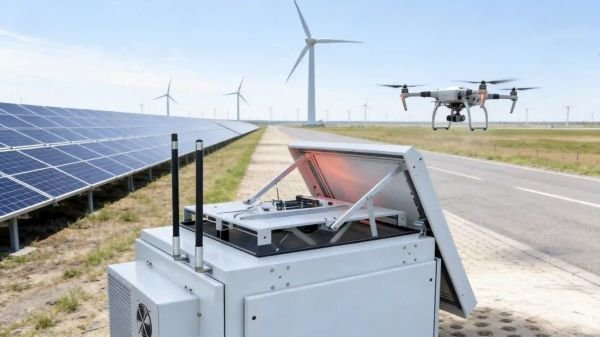
A Drone Hub provides a fixed operating point for drone missions. Depending on the system configuration, it can support scheduled flights, automatic takeoff and landing, charging, remote monitoring, and inspection data transfer.
1. Plan Repeatable Inspection Routes
Operators can establish flight plans for selected turbines, blade surfaces, tower sections, and surrounding infrastructure.
Repeatable routes help teams revisit the same assets and organize images consistently. Routes should be adapted to turbine geometry, nearby obstacles, flight restrictions, and current weather conditions.
For wind farms with many turbines, mission planning can also help prioritize assets according to maintenance schedules or previously identified issues.
2. Capture Detailed Images of Blades and Towers
A drone equipped with a suitable high-resolution camera can capture close-range images of accessible blade surfaces and tower sections.
These images may help identify visible signs of erosion, cracks, surface damage, or corrosion. Thermal cameras can also be used for specific inspection tasks when the application, payload, and operating conditions justify their use.
Image quality depends on camera capability, flight distance, lighting, aircraft stability, and the inspection objective. Not every defect can be identified from aerial imagery alone.
3. Return to the Drone Hub for Charging
After completing a mission, the drone returns to its designated hub for landing and charging, where supported by the selected configuration.
This can reduce the need for personnel to travel to the aircraft for every routine flight. It also provides a foundation for recurring remote inspection operations.
However, automated deployment does not mean uninterrupted operation in every condition. Wind limits, precipitation, communications, power availability, and equipment status must all be considered.
4. Organize Findings for Maintenance Teams
Inspection images can be transferred to a digital platform for review. Where supported, image-analysis tools can help flag potential defects and organize findings by turbine, blade, or location.
Maintenance teams can then review the evidence, assign priorities, and determine whether a closer inspection or repair is needed.
AI-generated alerts should be treated as findings for verification rather than automatic confirmation of a structural defect. A clear reporting process helps turn aerial images into useful maintenance information.
Key Benefits of Drone Hub-Based Inspections
More consistent inspection procedures. Planned missions can help operators apply similar image-collection methods across multiple turbines and inspection cycles.
Reduced routine travel. Remote operations can reduce the need for teams to visit every turbine simply to collect aerial images, although technicians may still need to attend for verification and repairs.
Better maintenance records. Organized images and location-based findings make it easier to track changes, compare inspection results, and prepare follow-up work.
More flexible inspection planning. Operators can schedule missions around maintenance priorities and suitable weather windows, subject to operational and regulatory requirements.
Support for preventive maintenance. Repeated inspections may reveal changes that warrant investigation before they develop into more serious problems.
These benefits are not guaranteed percentage improvements. Actual results depend on site conditions, inspection frequency, equipment selection, and the existing maintenance workflow.
What Should You Consider When Choosing a Drone Hub?
Before deploying a Drone Hub for wind turbine inspection, evaluate the following requirements.
- Camera compatibility: Confirm that the aircraft can capture the image detail required for blade and tower inspections.
- Flight planning: Check whether routes can be adapted to different turbine models, blade positions, and site layouts.
- Weather resilience: Verify the operating limits of the complete system, particularly for windy or coastal environments.
- Charging and power: Assess the available power supply and the charging requirements of the selected aircraft.
- Data analysis: Understand how images are stored, reviewed, mapped, and incorporated into inspection reports.
- Integration: Consider whether findings can be transferred into existing maintenance or asset-management systems.
- Safety and compliance: Establish appropriate permissions, risk assessments, and procedures for abnormal situations.
Wind turbine inspection standards and maintenance procedures remain essential. For background on blade engineering and lifecycle requirements, see the IEC 61400-5 wind turbine blade standard. Drone imagery should complement, not replace, the inspections and assessments required for the specific turbine and maintenance task.
How EFLY Supports Wind Power Inspection
EFLY provides drone hub and automated inspection solutions for industrial applications. Its Wind Power Drone Inspection solution describes aerial inspection workflows for wind turbines, including visual and thermal imaging, potential defect identification, and digital inspection data.
For operators evaluating a deployment, the appropriate setup depends on turbine location, inspection objectives, camera requirements, weather conditions, and the desired level of automation.
EFLY’s broader Drone Hub solutions combine hub hardware, compatible aircraft, and software to support automated inspection workflows. The specific configuration should be selected according to the requirements of the wind farm rather than assuming that one system fits every site.
Conclusion
Drone Hubs can make wind turbine inspections more systematic by connecting repeatable flight missions, aerial image collection, charging, and digital reporting.
They do not eliminate every inspection challenge, and complex defects may still require specialist assessment. However, for wind farm operators seeking more consistent routine monitoring, a Drone Hub can provide a practical foundation for organizing inspection activities and maintenance records.
To discuss your wind turbine inspection requirements and explore suitable configurations, contact EFLY.