
Drone hub Are Reshaping the Efficiency Frontier of Inspections – From Piloted Flights to Automated Operations
If the past decade was about proving that drones can fly, the next decade will be about proving they can fly continuously, at scale, and autonomously.
Across power line inspections, smart transportation, energy asset management, mining operations, and logistics, a growing number of enterprises are discovering a critical bottleneck: the real limitation isn’t the drone itself—it’s the operational ecosystem behind it.
A single drone can complete one mission. But a drone hub enables that same aircraft to operate around the clock, without human intervention.
That is precisely why drone hub are rapidly becoming industrial infrastructure.
From Occasional Flights to 24/7 Operations
Traditional drone operations typically involve a manual workflow:
- Transporting equipment to the site
- Swapping batteries by hand
- Manually launching and recovering the aircraft
- Downloading and processing data on-site
- Performing routine maintenance
This approach works for one-off tasks but struggles to support high-frequency, large-scale inspection programs.
With a drone hub deployed, the entire process transforms:
- Automated bay doors open for takeoff and landing
- Intelligent charging systems replenish power automatically
- Drones return, recharge, and relaunch without human input
- Remote mission planning and real-time fleet management become possible
In effect, drone hub act like telecom base stations—permanently stationed in the field, ready to operate on demand. For enterprises, deploying an hub isn’t just about installing hardware; it’s a fundamental upgrade to their operational model.
Why Drone hub Inspection Is Becoming an Industry Standard
Drone hub-based inspection is rapidly gaining traction in power grids, transport networks, renewables, and mining—and for good reason.
Infrastructure assets are growing in both size and complexity, while manual inspection capacity remains constrained.
Take the renewable energy sector as an example: public data shows that wind and solar installations continue to expand, with individual sites often covering tens of square kilometers or more. Traditional inspection methods struggle to balance coverage, frequency, and response time. By contrast, automated drone-in-a-box systems have demonstrated dramatic efficiency gains in real-world deployments. For instance, China Three Gorges Corporation’s drone inspection system across 12 renewable energy stations has saved over 110,000 labor hours annually, achieving a 13.2-fold increase in inspection efficiency.
By deploying a drone hub system, operators can achieve:
- Scheduled, autonomous patrols
- Automated re-flights when anomalies are detected
- Onboard AI-powered defect recognition
- Real-time data transmission to central control rooms
- Coordinated operations across multiple hub
This explains why more energy companies are investing in drone hub networks—not as experiments, but as mission-critical assets.
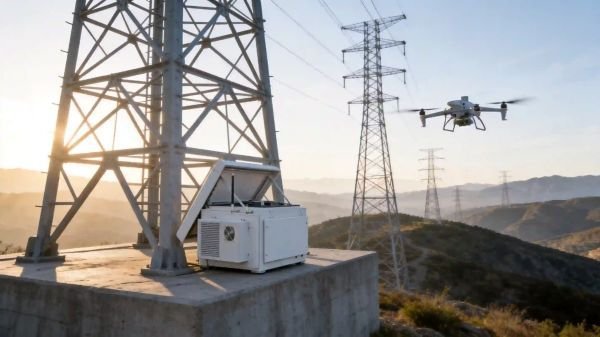
The True Value of a efly Drone hub: More Than a Landing Pad
Many first-time buyers assume a drone hub is simply a smart landing platform. In reality, it functions as the command and control hub for the entire drone operation.
A typical industrial efly drone hub includes:
- Automated lidar or vision-based landing guidance
- Smart battery charging and storage systems
- Built-in weather sensors (wind, temperature, humidity)
- Task scheduling and flight planning engine
- High-bandwidth video and telemetry downlink
- Remote health monitoring and diagnostics
In other words: the drone flies, but the hub operates.
Only when drones can operate autonomously—without on-site pilots or technicians—does large-scale deployment become commercially viable.
From Power Grids to Low-Altitude Economy – hubs as Infrastructure
Today, drone hubs are already deployed across a wide range of sectors:
- Transmission line and substation inspections
- Solar PV farm monitoring
- Wind turbine blade inspections
- Highway and bridge structural surveys
- Mine slope stability and tailings dam monitoring
- Port and terminal operations
- Campus and industrial park logistics
- Emergency response and disaster assessment
As the low-altitude economy gains momentum, drone hub systems are evolving from vertical-industry tools into core components of urban air mobility infrastructure.
In the near future, cities may deploy drone hubs as routinely as they install cellular base stations today.
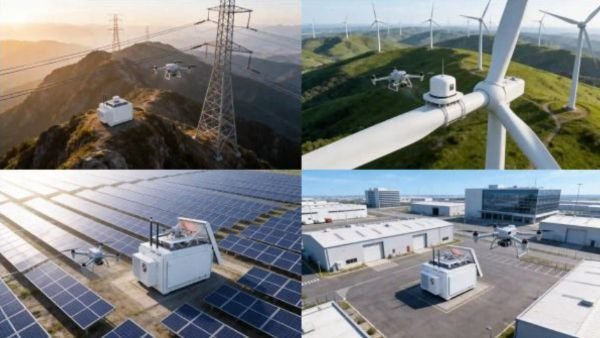
Airports on the Ground, Efficiency in the Sky
A better drone improves mission efficiency.
A drone airport improves system efficiency.
When hub can launch, land, recharge, and replan missions automatically—without human intervention—enterprises gain more than just labor savings. They gain higher data acquisition frequency, faster incident response, and the ability to scale inspections across vast geographies with minimal marginal cost.
The deployment of drone hub isn’t just about hardware installation.
It’s about unlocking a new efficiency frontier for the entire industry.
And as low-altitude infrastructure matures, drone hub will become as ubiquitous as servers, charging stations, and network nodes—transforming drone-based inspection from an innovative pilot into a standard operational practice.