
Drone Hub Inspection vs. Manual Inspection: A Paradigm Shift in Efficiency and Safety
Introduction: The Inspection Crossroads
A line worker carries binoculars, walking for hours beneath transmission lines. A single community inspection takes one hour. A quarterly substation inspection covers only three rounds. A full port area inspection takes three days. This is the daily reality of traditional manual inspection.
The drone hub is rewriting this decades-old operational logic. Drones launch from autonomous docking stations, complete community inspections in 3-5 minutes, accomplish in half a day what manual teams need three days to finish, and stand ready 24 hours a day. This is not merely a tool upgrade—it is a fundamental shift from “people walking” to “machines flying.”
Efficiency: From Hours to Minutes
The efficiency bottleneck of manual inspection is physical. Inspectors are limited by walking speed, terrain obstacles, and weather conditions. Daily effective inspection time is severely constrained.
Drone hub inspection delivers order-of-magnitude improvements. The IEEE recommended practice for UAV substation inspection formalizes this transition, establishing technical specifications that enable safer, more reliable, and more efficient inspections compared to traditional ascending operations. The purpose is clear: prevent risk to operations and maintenance personnel from ascending operations while increasing the safety and reliability of the power grid.
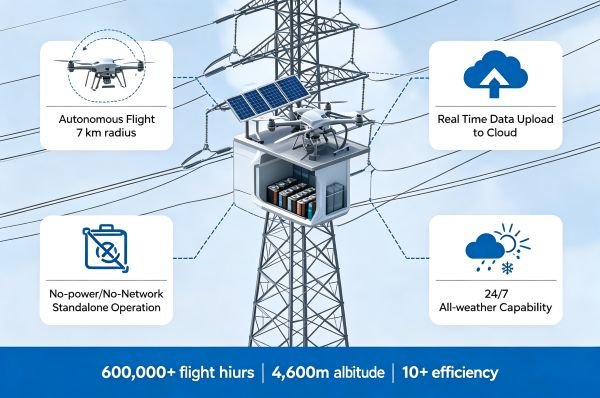
Real-world deployment data confirms the magnitude of change. In Xinjiang’s Bazhou region, the first photovoltaic-energy-storage “tower-mounted” drone hub achieved nearly 10 times the efficiency of manual patrols. The system completes grid-based inspection tasks covering transmission and distribution lines within a 5-kilometer radius of the hub, with fully autonomous takeoff, landing, and data upload capabilities.
This efficiency gain is not isolated. The drone-in-a-box market report confirms that autonomous systems provide continuous operations, boost productivity, and support real-time monitoring across security, agriculture, and infrastructure inspection applications.
Cost: From Labor-Intensive to One-Person-Multi-Site
Manual inspection costs scale linearly with mileage. Drone hubs restructure the cost model entirely.
The economic case is particularly compelling in solar inspection. Industry benchmarks show manual inspection costs $800 to $1,200 per MW, while AI-powered drone inspection costs $150 to $500 per MW. On a 50 MW site, this translates to $40,000-$60,000 for manual inspection versus $7,500-$25,000 for AI drone inspection—a cost reduction exceeding 50%.
The coverage speed difference compounds the savings. Manual inspection requires 25 to 50 working days for a 50 MW site, while AI drone inspection completes the same scope in 1 to 2 days. This speed advantage means faults are detected and repaired weeks earlier, recovering lost generation revenue that manual inspection cycles leave invisible.
Coverage: Breaking Physical Limits
Manual inspection has inherent blind spots. Locked construction barriers require detours or climbing. High-rise facades require ladders. Nighttime and adverse weather degrade inspection quality dramatically.
Drone hubs overcome these limitations. The tower-mounted hub in Xinjiang demonstrates deployment in no-power, no-network, no-elevated-structure field scenarios, mounted directly on transmission tower tops with structural stability and rapid deployment. The photovoltaic and energy storage system enables continuous operation even during nights or low-light conditions.
The market report confirms that drone hub systems are designed for persistent and repeatable operations, allowing drones to be stationed in fixed locations for scheduled or event-triggered missions such as security patrols, infrastructure inspection, perimeter monitoring, and emergency response support.
Safety and Accuracy: From Human Eyes to AI Detection
Manual inspection accuracy depends on inspector experience and attention. Long repetitive shifts produce visual fatigue. Subtle defects—hot spots, micro-cracks, early-stage corrosion—are routinely missed.
AI-powered drone inspection achieves above 94% fault classification accuracy, substantially higher than manual thermal review, according to published research in IEEE Transactions on Energy Conversion. The Omdena analysis confirms that manual inspection fault detection accuracy ranges from 60-75%, consistently missing early-stage PID degradation, micro-cracks, and partial soiling.
The safety improvement is even more fundamental. IEEE standards explicitly state that UAV inspection helps prevent risk to operations and maintenance personnel from ascending operations. The tower-mounted hub eliminates the need for workers to climb high-voltage structures for routine inspection tasks.

Comparison at a Glance
| Dimension | Manual Inspection | Drone Hub Inspection | Source |
|---|---|---|---|
| Inspection Time | 25-50 days (50 MW site) | 1-2 days | Omdena |
| Fault Detection Accuracy | 60-75% | 94%+ | Omdena |
| Cost per MW | $800-$1,200 | $150-$500 | Omdena |
| Efficiency vs. Manual | Baseline | ~10× improvement | SGCC |
| Report Turnaround | 3-6 weeks | 24-72 hours | Omdena |
| Operating Coverage | Daylight, clear weather | 24/7, all-weather | Market Report |
| Personnel Risk | High (climbing, exposure) | Near-zero | IEEE |
Regulatory Framework Supporting the Transition
The shift toward autonomous inspection is supported by evolving regulatory frameworks. The FAA Part 107 regulations establish the operational requirements for commercial drone operations, including pilot certification and flight rules that enable routine industrial inspection. These regulations provide the legal foundation for drone hub operations in the United States.
In Europe, EASA has issued proposals to introduce a “U-space light” category of drone traffic management systems, explicitly designed to enable large-scale BVLOS operations quickly and at scale across EU Member States. A survey of 11 EASA Member States identified 496 active BVLOS operational authorisations, with 89 reported as economically viable operations. This regulatory evolution directly supports the expansion of autonomous drone hub deployment for infrastructure inspection.
Conclusion: Not Replacement, But Evolution
The core difference between drone hub inspection and manual inspection is not “who replaces whom,” but a fundamental restructuring of operational logic.
Manual inspection is fundamentally about “people arriving on-site to observe,” constrained by human physical capabilities—walking speed, climbing height, visual precision, and fatigue resistance. Drone hub inspection is fundamentally about “automated data collection and intelligent analysis,” elevating the human role from executor to decision-maker.
Efly has been pioneering this field since 2012. The company’s solar-powered drone hub systems have achieved deployments at 4,600-meter altitudes in Sanjiangyuan National Park and completed globally pioneering tower-mounted hub installations on ultra-high-voltage transmission towers. With over 600,000 cumulative flight hours, Efly has validated the reliability of drone hub inspection in the most demanding environments.
The market trajectory confirms this direction. The drone hub systems market is projected to reach $98 million by 2032, driven by growing adoption of fully autonomous drone docking and charging ecosystems, increasing demand for continuous real-time monitoring, and rising use of these systems for risk reduction in hazardous environments. The transition from manual to autonomous inspection is not a question of if—it is a question of when.
If you’re considering a drone hub for your operations, we’d love to hear from you. Contact Efly — we’re here to help.